Course: SOCIAL NETWORK ANALYSIS 2024-2025 | Moodle Scienze umane

  • Interdisciplinary Projects

  • Lectures content


    • Le1 - Thu Oct 3, 2024 Introduction to the course, What is social network analysis, What is a network, Examples of networks, Introducing the class, their own background and their expectation on the course

    • Introduction to content and teaching methods

    • Le2 - Fri Oct 4, 2024 Social cognition and social network analytics, Networks of people, Psychometric network, Semantic networks, The process of a network project, Define problem and purpose, From questions to indicators: an example with #climatechange call for action discourse on Twitter. Networks as graphs; Directed and undirected networks; Examples; Weighted and signed graphs.

    • Le3 - Thu Oct 10, 2024 Weighted and signed graphs; The adjacency matrix: symmetries and conventions; Sparsity; Bipartite graphs; Projections; Distances, Small world, Connectivity, Bridges, Wooclap on project topics.

    • Le4 - Fri Oct 11, 2024  Building my personal network; Selecting the data; Defining the network, network boundaries; Random sampling, reputational and positional/structural approaches; Social capital, Entativity, Ostracism, Cohesion, Borokerage, Granovetter's weak tie theory, Weak ties, bridges, and structural holes, Efficient and effective networks. 

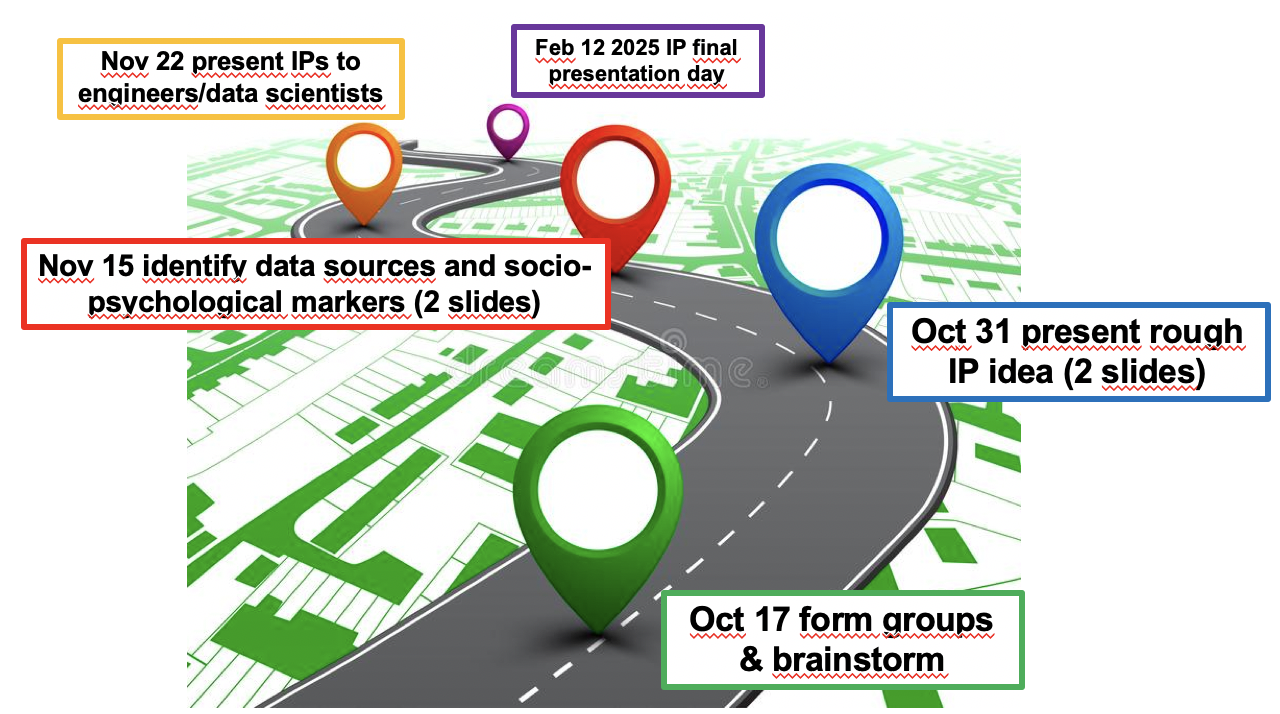
    • Le5 - Thu Oct 17, 2024 Brainstorming session on project topics and group forming

    • Le6 - Thu Oct 24, 2024 Centrality measures; Degree for undirected and directed networks; Average degree; Authorities and hubs; Degree distribution; Log-log plot of the degree distribution; Power-law and scale-free networks; Explaining the pwoer-law with preferential attachment and attactiveness.

    • Le7 - Fri Oct 25, 2024  Structural holes: Examplary of study linking personality, network and performance. Literature search; How to theoretically ground your research ideas in scientifically sound evidence; Tools and methods to look for literature search using online sources from key work planning to content management: how to assess journal authority; How to select relevant manuscripts; How to evaluate the quality of papers; scholar.google.com and www.webofscience.com or www.scimagojr.com

    • Le8 - Thu Oct 31, 2024 Project ideas presentations: 1) Overtourism, 2) Trad wives, 3) Abortion, 4) Privacy.
    • Le9 - Thu Nov 7, 2024 Project ideas presentation: 5) Natural disaster and climate change, 6) Veganism.

    • Le10 - Fri Nov 8, 2024 Language and social cognition; linguistic cues of psychological processes and inter group relations: focus on linguistic abstraction, generic masculine, derogatory labels and reappropriation, order and primacy effect; 

    • Le11 - Thu Nov 14, 2024 Semantic networks: Issues about text retrieval, mining, and coding; Overview of properties coded with LIWC dictionary.

    • Le12 - Fri Nov 15, 2024 Project discussion with an emphasis on literature search: 1) Overtourism, 2) Trad wives, 3) Abortion, 4) Privacy, 5) Climate change, 6) Veganism.

    • Le13 - Thu Dec 21, 2024 Invited talk by Magda Formanowicz on Agency

    • Le14 - Fri Nov 22, 2024 - 16:30pm @ Classroom Ce, DEI, via Gradenigo 6/b  Presentation of interdisciplinary projects to engineers/data scientists 

      16:30 Intro,

      16:35 Overtourism, 

      16:45 Trad wives, 

      16:55 Abortion, 

      17:05 Privacy,

      17:15 Climate change,

      17:25 Veganism,

      17:35 Discussion and group forming,

      18:00 End.

    • Le15 - Thu Nov 28, 2024 PageRank centrality: the random walk rationale; Teleportation; Pagerank versus degree; Examples; Local PageRank and topic specific PageRank; Examples of application; Other centrality measures: betwenness, closeness.

    • Le16 - Fri Nov 29, 2024 Social influence, contagion, homophily, and polarization; Le Bon's social contagion; Homophily in peoples' networks according to different behaviours: distinguishing homophily from contagion; Coviello's experiment on mood and weather as an example of contagion; Bond's example of contagion on elections through Facebook: a field experiment showing the power of small manipulation in the context of voting behaviors; Social contagion spreads faster across strong ties, with important consequences for the political involvement of crowds.

    • Le17 - Thu Dec 5, 2024 Community and topic detection; Conceptual picture of a network and its relation to Granovetter's theory; The core-periphery model; Overlapping communities; The Louvain algorithm; BERTopic; Using community detection: topics interdependencies.

    • Le18 - Fri Dec 6, 2024 The CAN (Causal Attitude Network) model conceptualizes attitudes as networks consisting of evaluative reactions and interactions between these reactions; Correlation networks. 

    • Le19 - Thu Dec 12, 2024 Feedback from IPs; Polarisation, homophily, selective exposure; Echo chambers and filter bubbles; Examples; Polarisation in pro-life/pro-choice networks; Assortative and disassortative networks;. 

    • Le20 - Fri Dec 13, 2024 Reddit Lab: how to scrape data from social networks by using R. by Bruno Gabriel Salvador Casara

      Below are some important links and information to prepare for the lesson.

      Installing R and RStudio
      For the lesson, you will need to download and install both R and RStudio. 

      You can install R from https://cran.r-project.org/

      and RStudio https://posit.co/downloads/

      Please follow the instructions provided on these websites. If you encounter any issues during installation, feel free to contact me.

      Attention Mac Users
      While I’ve tested the code several times and it always works for me, I’ve noticed that Mac users sometimes encounter problems with R libraries that are difficult for me to troubleshoot since I’m not familiar with Apple products. I would like to ask all students, especially those using a Mac, to check if you can install and load the required R libraries, and try running the attached R script. This way, we can address any issues before the lesson. If something doesn’t work, please let me know as soon as possible.

      The R script is available in the course website for you to download.

      I look forward to seeing you all!
      Best regards,
      Gabriel

    • Le21 - Thu Dec 19, 2024 Gephi Lab: how to give networks a graphical representation through the open-source software Gephi https://gephi.org/. by Lejla Dzanko

    • Le22 - Fri Dec 20, 2024 IP projects feedback.

  • Video lectures from past years