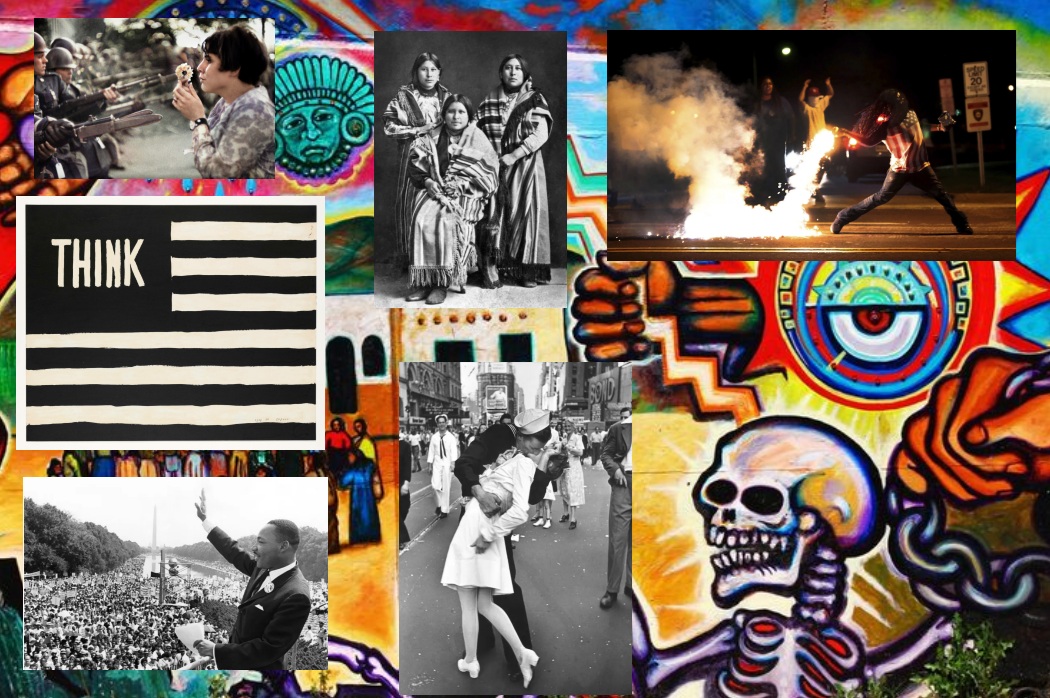
Taking Martin Luther King Jr.’s idea that peace is not just the absence of war but the presence of justice we will look beyond war as a battlefield event to see it as a system of violence that has shaped U.S. history: from colonization and genocide to slavery, extractivism, gender-based violence, and imperial expansion.
‘America’ was founded on promises of freedom and refuge from European conflicts, religious persecution, and class struggle. Yet its rise depended on the dispossession and extermination of Indigenous peoples, the enslavement of Africans, and a long history of military conquest. Alongside these legacies of violence stand powerful traditions of anti-war thought and non-violence activism: from Thoreau’s refusal to support the Mexican-American War to Martin Luther King Jr.’s critique of Vietnam, from draft resisters to anti-imperialist feminism.
After an initial historical and cultural overview, we will focus on literary texts to analyze how race, class, gender, and ethnicity shape American identities in relation to war and conflict, and how writers and artists have questioned dominant myths of patriotic violence. Through literature, film, music, historical documents, visual art, and popular culture, we will explore counter-stories of nonviolence, solidarity, and resistance.
‘America’ was founded on promises of freedom and refuge from European conflicts, religious persecution, and class struggle. Yet its rise depended on the dispossession and extermination of Indigenous peoples, the enslavement of Africans, and a long history of military conquest. Alongside these legacies of violence stand powerful traditions of anti-war thought and non-violence activism: from Thoreau’s refusal to support the Mexican-American War to Martin Luther King Jr.’s critique of Vietnam, from draft resisters to anti-imperialist feminism.
After an initial historical and cultural overview, we will focus on literary texts to analyze how race, class, gender, and ethnicity shape American identities in relation to war and conflict, and how writers and artists have questioned dominant myths of patriotic violence. Through literature, film, music, historical documents, visual art, and popular culture, we will explore counter-stories of nonviolence, solidarity, and resistance.
- Docente: Renata Morresi