SOCIAL NETWORK ANALYSIS 2020-2021
Schema della sezione
-
Lecture hours (starting Oct 1st, 2020)
Thu 10:30-12:00 (room 13)
Fri 10:30-12:00 (room 13)Instructors
Dual teaching
Tomaso Erseghe, tomaso.erseghe@unipd.it
Caterina Suitner, caterina.suitner@unipd.it
The course unit is delivered simultaneously in classroom and on-line
We are in classroom 13 @ Complesso Beato PellegrinoWe are also on-line @ https://unipd.zoom.us/j/95909296178 (same link as usual)
-
-
Le1 - Thu Oct. 1, 2020 Introduction to the course, textbooks, prerequisites, the meaning of social network analysis as from wikipedia, interdisciplinary projects in collaboration with the twin course of network science, discussion.
Le2 - Fri Oct. 2, 2020 Social cognition and social network analytics, Social network game, Bonding and bridging social capitals, Entitativity and ostracism, The cyber ball, Cohesion and brokerage, Granovetter's weak tie theory, Weak ties, bridges, and structural holes, Efficient and effective networks.
-
-
Le3 - Thu Oct. 8, 2020 Networks as graphs; Directed and undirected networks; Examples; Weighted and signed graphs; The adjacency matrix: symmetries and conventions; Sparsity; Paths, Cycles, Distances and Diameter; Small world concept; Connectivity, Giant component, Bridges; Bipartite graphs.
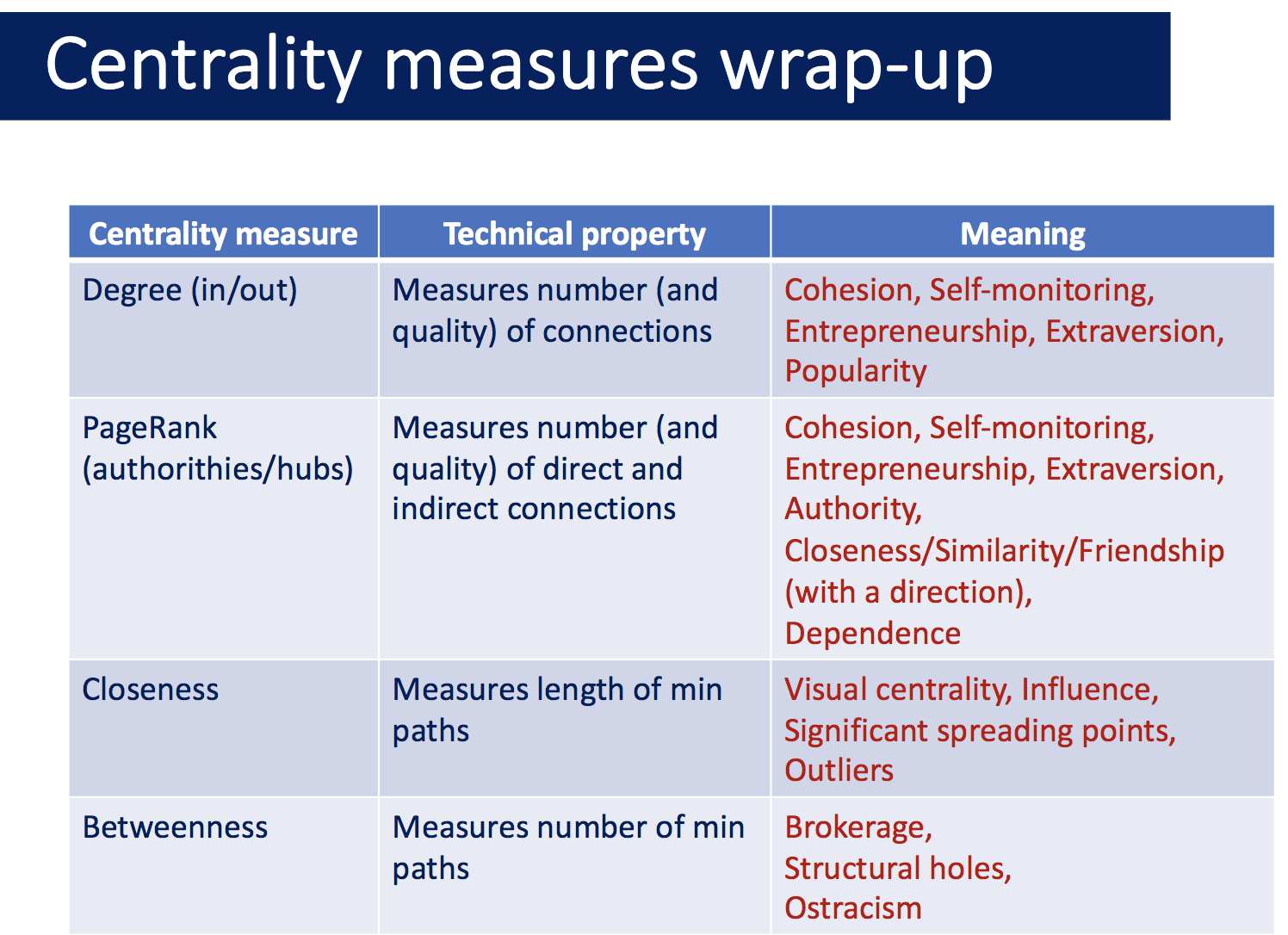
Le4 - Fri Oct. 9, 2020 Bipartite graphs; Projections; Centrality measures; Degree for undirected and directed networks; Average degree; Authorities and hubs; Degree distribution; Loglog plot; The power-law and scale-free networks; Preferential attachment and attractiveness.
Le5 - Thu Oct. 15, 2020 PageRank centrality: the random walk rationale; Solution to dead ends and spider traps: the teleportation vector; PageRank versus degree centrality; Tuning the teleport vector: local PageRank; Examples of application; Closeness centrality.
-
Le12 - Thu Nov. 5, 2020 Polarisation, homophily, selective exposure; Echo chambers and filter bubbles; Examples; Polarisation in pro-life/pro-choice networks; Assortative and disassortative networks; Nearest neighbour degree; Structural disassortativity.
Le13 - Thu Nov. 12, 2020 Clustering coefficient; Network robustness; Robustness of scale-free networks; Robustness to attacks; Optimizing robustness; Example with Tweets sentiments; Link prediction task; Common neighbours and Resource allocation; Random walk techniques; Example with the pasta recipes network.Le16 - Thu Nov. 20, 2020 Conceptual picture of a network and its relation to Granovetter's theory; Algorithmic approaches; The core-periphery model; Overlapping communities.
-
-
-
-
This demonstration shows that even mild preferences to be near members of one's own group can lead to extreme segregation.
 ■Segregation is the separation of social groups by race, class, ethnicity, gender, or other recognizable characteristics.■Residential segregation refers to segregation in housing, whereas school segregation refers to differential access to educational facilities.Segregation: Schelling Effect■prejudice can lead to segregation■homophily leads to segregation■ to the separation of groups by race, gender, or other social categories■It was this type of segregation that Rosa Parks fought in 1955 when she refused an Alabama bus driver's demand that she move to the rear with other Black riders.■why does segregation still occur today in schools and other places where people support social equalityNobel Laureate Thomas Schelling proposed an answer in the 1970s, writing that racial discrimination arises not only from behavior that is "heartless, selfish and illegal" but "from the magnification of small incentives into massive results."
-
-
Le18 - Fri Nov. 27, 2020 Gephi Lab: how to give networks a graphical representation through the open-source software Gephi https://gephi.org/. by Lejla Dzanko
Le19 - Thu Dec. 3, 2020 Twitter and Reddit Lab: how to scrape data from social networks by using R. by Bruno Gabriel Salvador Casara
-
-
Applications: The goal of this unit is providing practical examples of how network projects tackle relevant social issues
Le8 - Fri Oct. 23, 2020 The relation between personality, structural position in the network and productivity.
Le10 - Fri Oct. 30, 2020 The CAN (Causal Attitude Network) model conceptualizes attitudes as networks consisting of evaluative reactions and interactions between these reactions.
Le14 - Fri Nov. 13, 2020 An application of network analytics to collective action. The relation between network types, motivation, and participation. Insights about removal effectiveness (and network robustness) in relation to removal type (targets vs. random), type of network, and collective emotions.
Le15 - Thu Nov. 19, 2020 A field experiment showing the power of small manipulation in the context of voting behaviors. Social contagion spreads faster across strong ties, with important consequences for the political involvement of crowds.
Le20 - Thu Dec. 10, 2020 Semantic networks: issues about text retrieval, mining and coding. Focus on linguistic cues of psychological processes and inter group relations. Presentation of the case study of climate change activism: investigation of a semantic network of tweets
-
-
-
-
-
-
-
-
-
-
-
Caricato il 17/12/2020 12:27
-
-
Le6 - Fri Oct. 16, 2020 Literature search: Seminar lecture about how to theoretically ground your research ideas in scientifically sound evidence. Tools and methods to look for literature search using online sources from key work planning to content management: how to assess journal authority, how to select relevant manuscripts, how to evaluate the quality of papers.
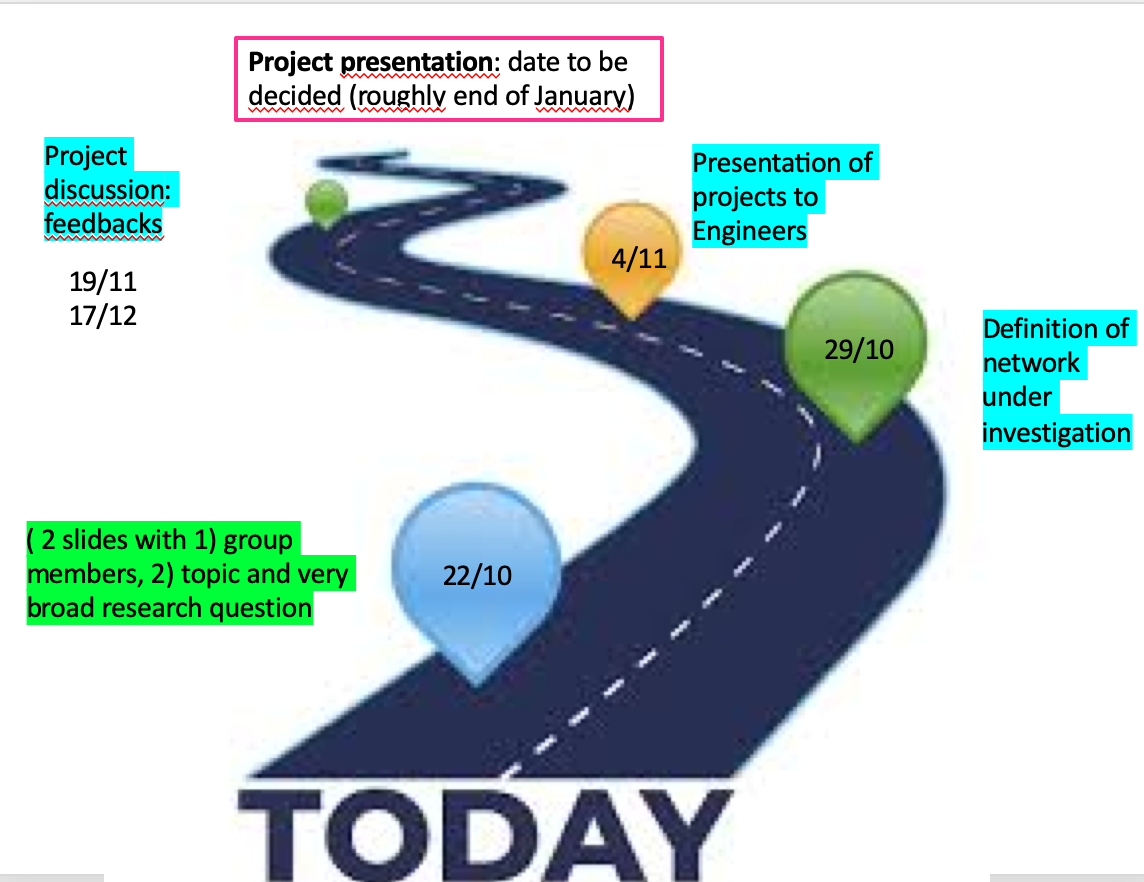
Le7 - Thu Oct. 22, 2020 Methodological insights about network project: The process project definition, identification of the social network, and its boundaries. Sampling Issues. Examples of applications. Presentation of groups and feedbacks of group activity.
Le9 - Thu Oct. 29, 2020 Projects discussion: 1) progressive taxation, 2) Erasmus attendance, 3) blacklivesmatter, 4) gender washing, 5) conspiracy.Le11 - Wed Nov. 4, 2020 Presentation of interdisciplinary projects: IP1 blacklivesmatter, IP2 Erasmus attendance, IP3 republican&democrats, IP4 QAnon conspiracy, IP5 progressive taxation, IP6 hate speech.
Le16 - Fri Nov. 20, 2020 Kickoff meeting for IP2 and IP6
Le17 - Thu Nov. 26, 2020 Kickoff meeting for IP1, IP3, IP4 and IP5
Le21 - Thu Dec. 17, 2020 IP project discussion and feedback
-
-
-
Caricato il 21/10/2020 17:16